
culture, behind the scenes
Emily Rodger: From reluctant subject to TV host, and a life transformed
Emily Rodger almost didn't send the email.
A friend had been nudging her for a while. You have a story, she kept saying. You should reach out to Hemmings House.
written by:hhadmindate published: Jun 04, 2026 content type: behind the scenes
Emily resisted. She'd had some success on the bike – world championships, national titles, a hard-won career in a sport she hadn't even discovered until adulthood.
But a film? About her? It didn't seem like enough.
Eventually she sent the email anyway.
What followed was the kind of chain reaction that looks inevitable only in hindsight. A lunch with Greg Hemmings and producer Stephen Foster.
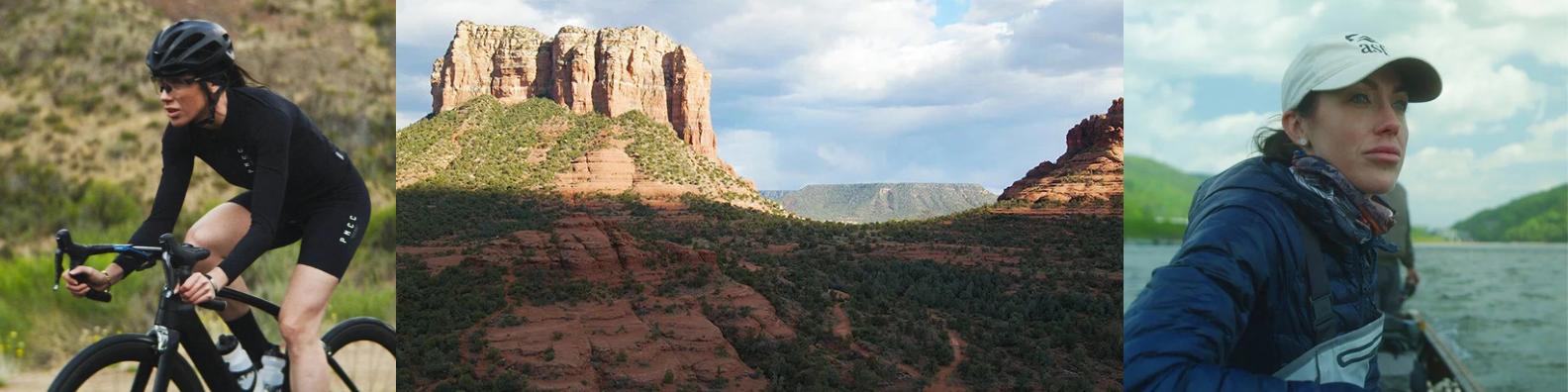
A tour of the Hemmings House studio that turned out not to be a tour at all – Greg was already recording The Boiling Point podcast, and as Emily walked through the door he introduced her as his next guest. She'd never been on a podcast before. She sat down anyway.
The woman who walked into Greg's studio as an unplanned guest would go on to co-host that same podcast alongside Vision Coaching founder Dave Veale – who introduced her to the world of leadership coaching – and eventually become a certified coach herself, a public speaker, a travel host and the star of her own Bell Fibe TV1 series.
“Stepping into that conversation with Greg changed the trajectory of my life in so many ways,” she says. “That's the first time I heard about executive coaching. If I hadn't said yes to just going and doing that podcast – or yes to just doing that film – all of those things would have been different.”
It's a pattern Emily has come to recognize in herself. The bike. The fly rod. The film. Say yes first. Make sense of it later.
Greg and Hemmings House were the through-line for all of it.
A story she wasn't sure she had
Cadence: Breaking Rhythm and Finding Pace began filming in 2021. The short documentary traces Emily's path from elite cycling through two catastrophic accidents – and what she found on the other side of them.
She had come to the sport as an adult and gone all the way to the professional peloton, winning world championships along the way.
Then, in 2013, a vehicle struck her during a training ride in Arizona.
Severe facial and head injuries. A brain injury. A long recovery complicated by post-traumatic stress disorder (PTSD). She fought back, returned and won again – until a second collision brought everything into question once more.
Fly fishing became the thing that steadied her – a childhood pastime rediscovered during recovery that gave her something the bike no longer could: stillness, presence, a way back to herself.
Emily was apprehensive about putting any of it on film.
“I didn't feel like it was a big enough deal,” she says. “And when you're working with a film production company, they're kind of in control of the narrative – you really need to trust the person you're working with.”
Greg earned that trust quickly. Calm under pressure, consistent in every environment, genuinely curious about the person in front of him rather than the story he was trying to extract – his manner put her at ease from the start.
“At the time, it was one of those moments where I really felt cared for,” Emily says. “The compassion that somebody else gives you, you then gain more of for yourself.”
Cadence screened at festivals internationally. CBC commissioned a longer version – Chasing the Current, which aired as an hour-long special on Absolutely Canadian in September 2022 and remains available on CBC Gem. The response across both versions followed a consistent theme.
People who had never touched a bicycle, never held a fly rod, kept telling Emily they saw themselves in it – in the loss of an identity they'd built their life around, in the hard work of finding a new one.
“It wasn't about the bike, it wasn't about fly fishing,” she says. “It was this common thing – that there are things in our lives that are going to be lost. How do we choose to move forward in them?”
Resilience in the face of five years of no
The films opened doors – public speaking engagements, a growing coaching practice, a broader audience for Emily's story. But she wanted to do more. She had seen what storytelling could do for the people who encountered it, and she wanted to create more of that. She and Greg started pitching TV show ideas.
Networks passed. Some concepts moved up the chain and got cut. A few were taken and handed to someone else. This went on for five years.
"Every single time it was, OK, no problem. Carry on. Do up the next pitch, and then do up the next pitch."
She kept going because she had a persistent sense that she and Greg were going to do something together that hadn't happened yet. Bell Fibe TV1 eventually said yes. The show is called Atlantic Pursuits, and it debuted April 30, 2026.
People see a TV show and think it just happened,” Emily says. “That was five years of being told no. Flat-out rejected, over and over again. And that is that resilience – that thing of you just keep putting something out there.”
Home ground
Atlantic Pursuits is four 20-minute episodes built around a single journey. Emily builds a chestnut canoe from scratch using original blueprints, launches it on the Miramichi watershed, then joins two Wabanaki chefs to forage and prepare a meal from what the watershed provides.
“A canoe is a staple of not just Canadian heritage, but Atlantic Canadian heritage,” she says. “Being able to use that canoe to meet people, to learn more about the Indigenous side of our culture and heritage here – that is really what this show is.”
What doesn't appear on screen is what Emily was carrying through every day of that shoot.
She had cancelled international travel to be home with her sister Jessica, whose health was declining. Each day she filmed, she drove back to be with her. The crew knew. They showed up for her the way she needed them to. She kept showing up for the work.
Jessica passed away in December 2025, before the series aired. Born with Down syndrome, she had spent her final years also living with Alzheimer's – a layer of loss that came far too soon.
Emily described her as someone who “quietly expanded everyone's understanding of what's possible” – loving, present, funny, deeply connected to the people around her. Hemmings House added a tribute to her at the close of the series.
“When I watch Atlantic Pursuits, I think about resilience and just choosing to move forward, no matter what it is that you're going through,” Emily says. “How can we take what we are going through and still move through life in the most grounded way?”
She had filmed an entire television series living exactly that question.
Atlantic Pursuits is now streaming on Bell Fibe TV1.
What it's like to work with Greg
Six years in, Emily knows exactly what working with Greg Hemmings is like.
“He is so intelligent – that man is a genius – yet he can speak to anyone in a way that connects. He's the same person in every single environment. He would not make it known that he was the expert in the room – he would be drawing on everybody else's skills, wanting to build people up,” she says.
"He has had that great of an impact on me. And it's something he hasn't even tried to do. That just happened by him being his genuine self."
She sent an email she almost didn't send. She sat down for a podcast she didn't know she was going to record. She said yes to a film she wasn't sure she deserved.
Not bad for someone who didn't think she had a story.
If you're working to share a story of resilience, document a remarkable journey, or bring an unlikely voice to a wider audience, reach out to the team at Hemmings House: hello@hemmingshouse.com.
Things to Read Next
The Film That Catalyzed a Movement
back to beyond the frame view next Click Here culture, behind the scenes Blog title…
Rethinking Success: The Story Behind the Millennial Dream
back to beyond the frame view next Click Here culture, behind the scenes Blog title…

How One Documentary Changed What Kids Learn
back to beyond the frame view next Click Here culture, behind the scenes Blog title…